





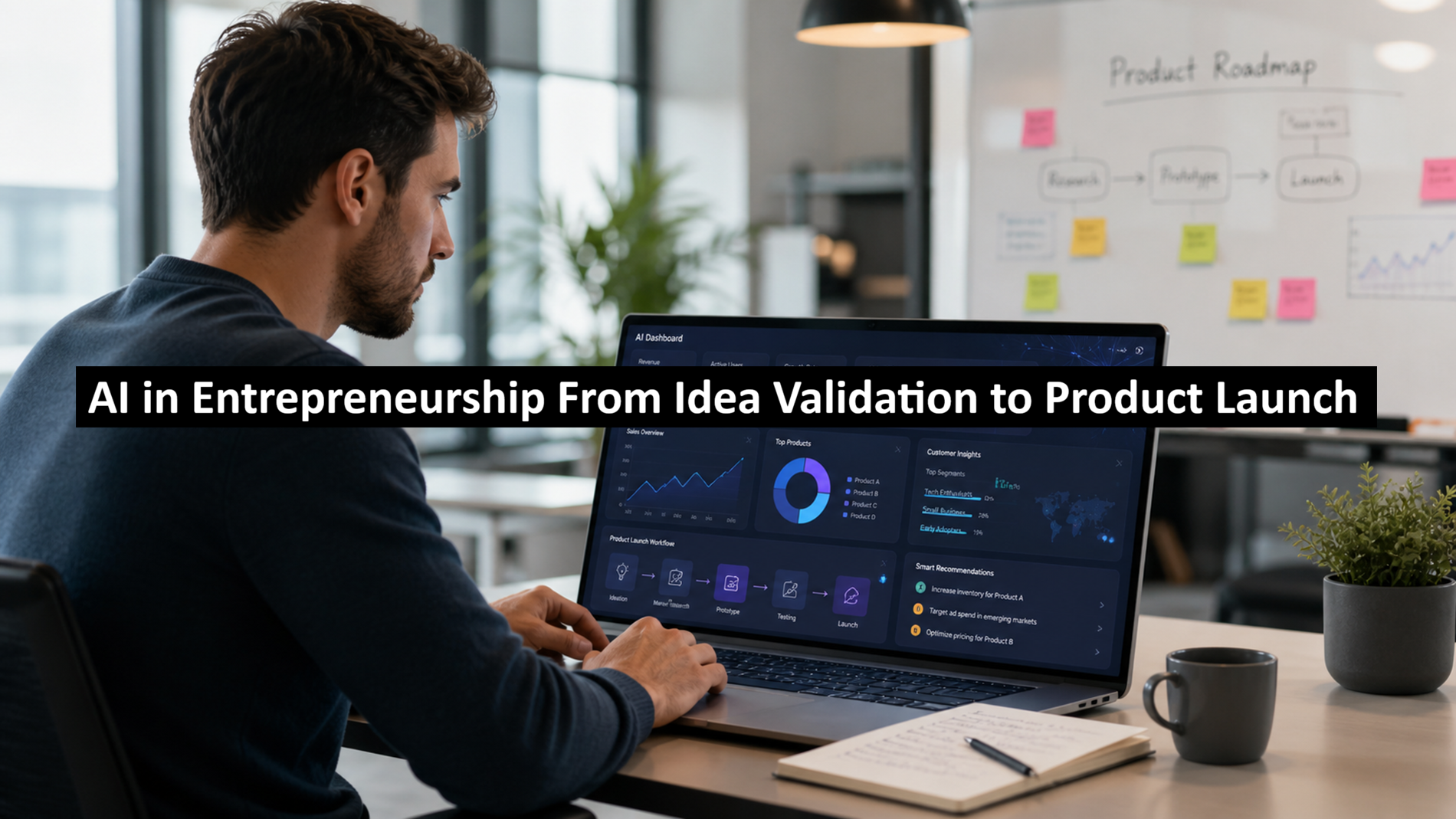
Today, artificial intelligence (AI) is rapidly progressing from science fiction to a practical business tool for entrepreneurs. AI can now be used not just for automation of repetitive tasks, but also for decision making, risk management, customer insight, and getting products to market faster. There are opportunities to leverage AI throughout the entire entrepreneurial journey from concept validation to product launch.
AI’s Role in Validating New Venture Concepts
When starting a new venture, the most significant hurdle is determining if there is a viable option to pursue and/or develop. The majority of businesses fail due to the existence of a product that does not fulfill an existing need. AI provides an analytical tool for validating a potential investment more empirically.
Market Research, Trend Analysis
Entrepreneurs can utilize artificial intelligence technology to assist in analyzing multiple factors that influence the success of a business’s product offerings; these include: market trends, consumer behavior, competitor actions, search behavior, and social media conversations about similar or related products. This will allow the entrepreneur to assess whether sufficient interest exists for their product idea before committing significant resources to develop it.
For instance, a developer of a fitness app may utilize AI technology to analyze consumer reviews of similar types of fitness applications to determine what current customers are expressing about these applications, what type of fitness-related products are being searched for, and what types of questions consumers are asking regarding similar types of products on social media platforms.
Read: 10 Tips For Tenderfoots To Contribute And Spare Cash Wisely
Customer Research, Audience Insight
In addition to assisting the startup company with market research, AI technology can also assist entrepreneurs with understanding their potential customer through the following activities: developing survey questions to further assess customer interest levels, thoroughly reviewing interview transcripts to determine what questions and/or themes are repeatedly raised by consumers; segmenting various subgroups based on similar demographical profiles or typical buying patterns, all of which will assist an entrepreneur in developing a value proposition.
Business Planning with AI
If you have a tested idea, the next thing you need is to create a business plan. At this stage, you will want to leverage AI in building out a business model, pricing strategy, financial projections, and go-to-market strategy.
Finding A Business Model
Using AI tools, entrepreneurs can evaluate several different types of business models, including subscription vs. one-time purchase, freemium products, marketplaces, etc. This will give them insight into how to build a model around their target customer, their product, and their long-term objectives.
Creating Financial Forecasts and Assessing Risk
While AI should not be the only source for obtaining expert financial or legal advice, founders can use AI to quickly explore various financial scenarios. For example, an AI application can assist you in estimating your expenses, predicting your revenue sources, comparing your pricing structure (vs. other companies in the industry), and outlining the possible risks associated with your business. Thus, entrepreneurs will have a much clearer understanding of how they want to proceed before selecting a particular strategy on which to focus their efforts.
Using AI in Product Development
AI can provide startup companies with a significant benefit in the product development space. New companies do not typically have a lot of capital, so they rely on speed and efficient processes.
Increasing the Speed of Prototype and Design
Using AI design aids can help create wireframes, user interface mock-ups, product descriptions, and branding designs, which allow entrepreneurs to take their initial idea and quickly develop a visual concept for the purpose of testing it with potential customers or investors.
Assisting Development Teams
AI Coding Assistants can be used by programmers to write, test, and debug code faster. Product Managers can utilize AI to create an organization for their feature sets, properly prioritize their assigned tasks, and create their user stories. AI does not offer the ability to create a successful product by itself. Entrepreneurs still need to utilize their Judgment, make Strategic decisions, operate within an understanding of emotional and cultural considerations, and provide a Solution to an important Problem.
Using AI in the Development Of Minimum Viable Products (MVPs)
AI also assists in developing MVPs. An MVP represents a simplified version of a product to test in the market by only including those critical functions that need to be tested for market validation purposes.
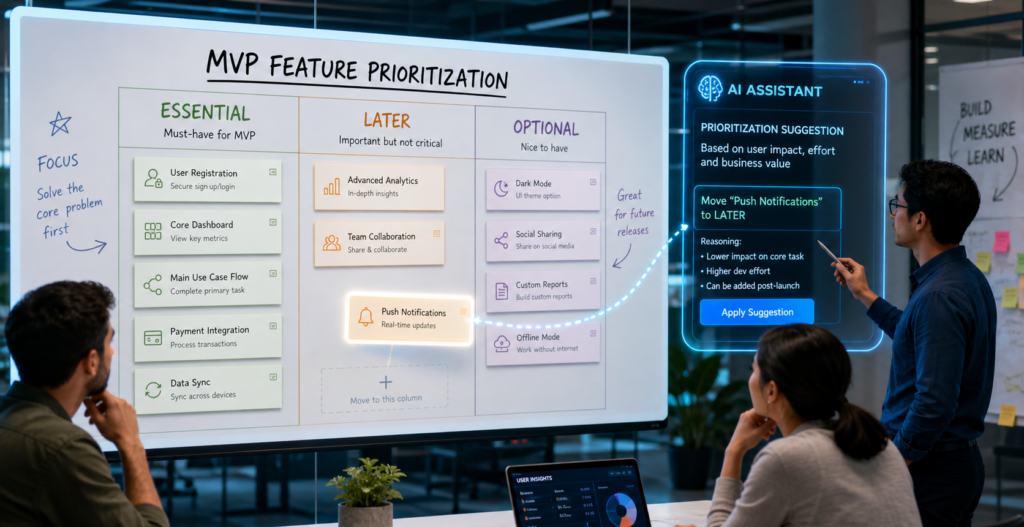
Prioritize Features
AI can help entrepreneurs in determining which functions are essential and which ones can be delayed. By examining the collected customer feedback and assessing the competing products, AI helps determine the function(s) most strongly correlated with customer satisfaction and loyalty. This allows businesses to build the right amount of product and to provide value to their customers as quickly as possible.
Analyze Feedback
When the early users of the MVP product are testing it out, AI will summarize the feedback collected and identify any common issues reported, and where product improvements may be necessary. This enables startups to modify their product to better meet the real-world needs of their customers, rather than what they believe to be the needs of their customers.
Post-Launch Growth and Optimization
When it comes to the optimization and future growth of a product after the launch, the use of AI will still be crucial. AI can help to monitor user behavior, review user feedback, provide monitoring of customer support requests and identify any issues or problems associated with the user experience at every stage of the customer journey from awareness to retention.
User Behavior Tracking
AI will allow for tracking user behavior, so if there are certain steps in the user’s purchase process that are keeping users from completing their purchase, the AI tools can provide insight into an issue that may exist. Entrepreneurs can then use this insight to make improvements to the onboarding process, simplify product flows, and eliminate any points of friction that exist within the customer journey that may hinder customer retention.
Customer Support Automation
AI chatbots and virtual assistants can assist startups in providing customers with customer support without the need to hire a large customer support team upon the launch of their product. Chatbots and virtual assistants are able to answer frequently asked questions (FAQs) from customers, provide support with basic customer support procedures, and provide businesses with valuable feedback regarding their experience with the company’s products or services. This can enable companies to provide a better customer experience while minimizing operational costs.
Challenges of Using AI in Entrepreneurship
While there are many advantages of AI, entrepreneurs must be careful when using it. The use of AI tools may lead to incorrect, biased, or generic results unless they are verified and handled carefully. It’s also important for entrepreneurs to ensure that all of their important information is accurate; protect any customer’s personally identifiable information (PII) from being accessed by the platform being used to create the original content; and not to become overly reliant on automated suggestions or recommendations as a source of information.
The best results will be obtained when an AI tool is treated like a partner and thoughtfully implemented into a human-driven creative process, and when businesses combine AI-generated customer insights and generative AI development services with true human input, which will ultimately enable the launch of their new business.