



A modern vehicle is no longer defined only by its engine, transmission, body, and wheels. Some of its most important capabilities now exist in lines of code. Software determines how efficiently an electric vehicle manages its battery, how a driver interacts with the infotainment system, how safety features respond to changing conditions, and how new functions can be delivered after the vehicle has already left the factory.
This transformation is changing the automotive industry at a fundamental level. Connected vehicles, artificial intelligence, cloud computing, advanced driver-assistance systems, and over-the-air updates are pushing automakers to develop capabilities traditionally associated with technology companies. While mechanical engineering remains essential, software development and digital infrastructure are becoming central to how vehicles are designed, manufactured, sold, and improved.
The Car Is Becoming a Computing Platform
For much of automotive history, innovation focused on mechanical engineering. Manufacturers competed through improvements in engines, transmissions, fuel efficiency, suspension systems, safety structures, and manufacturing techniques. Those areas remain important, but software increasingly connects many of a vehicle’s functions and determines how they work together.
Today’s vehicles can contain numerous electronic systems responsible for functions such as braking, battery management, climate control, navigation, entertainment, and driver assistance. Automakers are increasingly moving toward centralised computing architectures that allow these systems to communicate more efficiently. This can simplify vehicle design while giving manufacturers greater control over software development and future upgrades.
The ownership experience is changing as well. Over-the-air updates allow certain improvements to be delivered digitally rather than requiring a customer to visit a dealership. Software can potentially improve interfaces, navigation, vehicle performance, and selected driver-assistance functions throughout a vehicle’s life. This creates a different relationship between manufacturer and customer, where the vehicle can continue evolving after the initial purchase.
Electric Vehicles Are Accelerating the Shift
The growth of electric vehicles has helped accelerate automotive software development. Unlike conventional vehicles, EVs depend heavily on software to manage battery temperature, charging behaviour, energy consumption, regenerative braking, and motor performance. Effective software management can directly influence how efficiently an electric vehicle uses its available energy.
EV manufacturers have also demonstrated how closely vehicle development can overlap with technology development. Companies in this sector have invested heavily in centralised computing, digital interfaces, connectivity, artificial intelligence, and software updates. Established automakers are responding by developing their own digital platforms while attempting to preserve the manufacturing expertise and large-scale production systems built over decades.
This evolution has also changed how some investors examine automotive businesses. Discussion surrounding the Tesla share, for instance, frequently extends beyond vehicle production and sales to areas such as software, autonomous-driving technology, artificial intelligence, energy storage, and digital services. That broader discussion reflects how technology is becoming increasingly important to the perceived value and future direction of automotive companies.
Data Is Becoming a Critical Automotive Asset
Connected vehicles generate substantial amounts of information. Sensors, cameras, navigation systems, battery-management systems, and driver interactions can provide data that helps manufacturers understand how vehicles behave in real-world conditions. When collected and handled responsibly, this information can support vehicle development, maintenance, software improvements, and safety testing.
Data is particularly significant for advanced driver-assistance technology. These systems rely on software to interpret information from cameras, radar, and other sensors and respond within carefully defined operating conditions. Improving these systems requires extensive testing, simulation, validation, and analysis. As a result, software development becomes an ongoing process rather than something completed before a vehicle reaches the showroom.
The increased dependence on data also brings greater responsibility. Automakers must consider cybersecurity, privacy, reliability, and system validation alongside innovation. Industry regulators and safety organisations continue to emphasise that connected and increasingly automated vehicles require robust safeguards because software failures or cyberattacks can have consequences beyond those associated with ordinary consumer electronics.
Read: How to Re-Pitch Your Expat Business When the First Round Fails
Automakers Need Different Skills
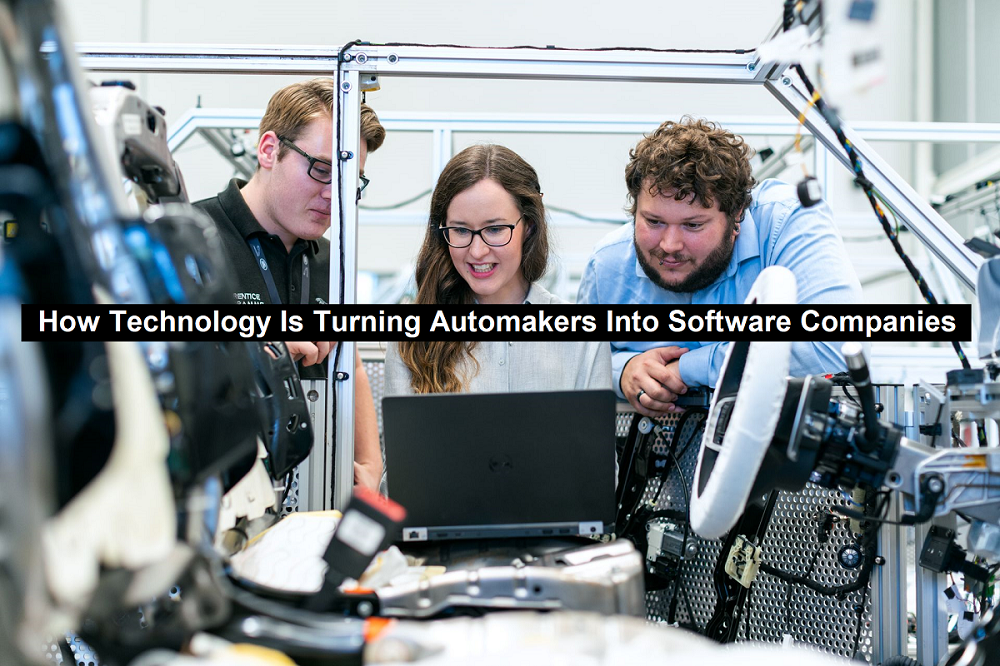
Becoming a software-driven organisation requires more than adding computers to vehicles. Automakers need specialists in software engineering, artificial intelligence, cybersecurity, cloud infrastructure, data science, user-interface design, and connected services. These capabilities complement rather than replace traditional automotive expertise.
Mechanical and electrical engineering remain essential because software ultimately controls or interacts with physical systems. Vehicles must operate reliably despite heat, cold, vibration, moisture, mechanical wear, and unpredictable road conditions. The challenge is therefore bringing software and traditional engineering disciplines together without compromising safety or reliability.
Organisational culture is changing too. Technology companies often rely on frequent software releases and rapid iteration, while automotive manufacturers have traditionally worked through lengthy development and validation cycles. Modern automakers must find a balance between these approaches. They need enough flexibility to improve software quickly while maintaining the rigorous testing and quality standards expected from products that carry people at high speeds.
Conclusion
Technology is fundamentally changing what it means to build and own a car. The vehicle is evolving from a largely fixed mechanical product into a connected platform that combines hardware, software, data, and ongoing digital services. Automakers must therefore develop technological capabilities while continuing to meet the demanding standards of traditional automotive engineering.
The companies navigating this transition will need to balance innovation with safety, convenience with privacy, and rapid software development with long-term reliability. For consumers, understanding this shift provides a clearer picture of why today’s automotive industry looks increasingly similar to the technology sector.